Blog directory Akshaya Patra Foundation: Akshaya Patra Kitchen | Akshaya Patra Blog

Donate and Save Tax

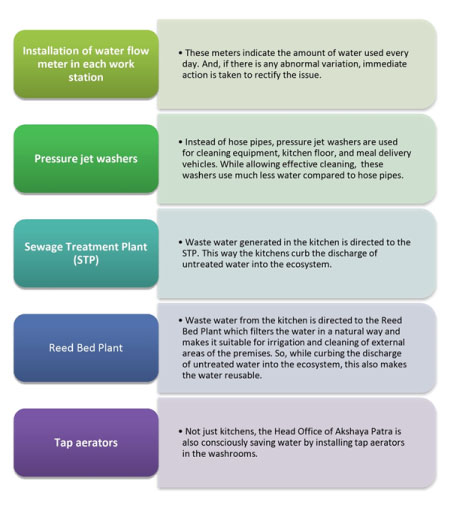
Water Conservation Methods at Akshaya Patra Kitchens

On the occasion of World Water Day which is going to be celebrating on March 22nd, Akshaya Patra likes to share few of its water conservation methods which are implemented in its kitchen. This NGO runs pilot projects in its kitchens focussing on every area of kitchen processes and upon achieving favourable results implements it in the daily operations. Some of the measures that have clearly resulted in reduced water consumption are:


To see complete details about the conservation methods and tips given by the beneficiaries, visit: World Water Day

Akshaya Patra Observes World Earth Day


Earth day is observed every year across the world on April 22nd to make people aware of the importance of protecting the environment. The irony is that despite celebrating for the last 46 years, we still are unaware of the means and ways of protecting our blue planet. Earth is the only planet in the universe where life is possible but if it is continuously abused without any restraint there will be no life at all soon. We should understand that, besides us, there are many other organisms that share our planet. Our Planet which had abundant resources needs to be preserved and conserved for future generations too.

Many governmental and non-governmental organisations have come up with programmes and initiatives to bring awareness to protect earth. Even though, Akshaya Patra is not directly related to conservation of earth, the organisation implements measures to preserve the environment. They implement many eco-friendly initiatives as:


  • ‘Bio Oorja’ kitchen stoves that use biomass pellets as fuel which has helped in minimizing fuel cost by 50%. 
  • The biogas plant produces about 40-50 kg of biogas from about 1000 kg of waste.  (Read Consuming with care blog to know more about biogas plant.)
  • LED lights have been installed in the kitchens that are extremely energy efficient. 
  • Recycling of water is done using Effluent Treatment Plant (ETP) and the waste water is used for washing vehicles used to transport the food. 
  • There are solar plants to reduce dependency on bio-fuels. Technological innovation measures are implemented that has the capacity to produce 70 units of power a day is used to run all the applications in the kitchen that work on single phase power like the computers, fans and other systems. The plant runs through the use of photovoltaic (PV) cells which convert sunlight to direct current electricity through the course of the day. 


Through  these measures, Akshaya Patra has reduced its dependence on non-renewable sources of energy.  By using data analytics, the number of meal delivery routes has been reduced by five, lowering the fuel consumption and vehicle emission each month.

All these measures by and large adopted by Akshaya Patra contribute in protecting our environment.  We should understand that it is not only on April 22nd, we have to observe earth day. Every day should be observed as Earth day to prevent our earth from being destructed further.


Follow us on:


How Akshaya Patra Feeds Over 1.5 Million Children Every Day?

Akshaya Patra started in 2001 by serving meals to around 1,500 children of five government schools in Bengaluru. The underlying thought was that children should not be deprived of education because of hunger. In 2004, when the Government of India launched its ambitious Mid-day Meal Scheme, Akshaya Patra’s expertise in the field came as an advantage. It helped the Foundation get into a public-private partnership with the Government for the implementation of this scheme.

Mid-day meal in schools

Over the course of 15 years, Akshaya Patra has established its kitchens in 24 locations and feeds over 1.5 million children of 11,360 schools across ten states. The role of NGO is to provide hygienic food to lakhs of children across the country. The journey from 1,500 children in Bengaluru to over 1.5 million children across the country would not have been possible if it was not for (i) technology and (ii) successful partnership with governments and other stakeholders.

Role of Technology

Necessity, they say, is the mother of invention. When the time came to scale up, Akshaya Patra had to resort to technology. Until then, the process mainly revolved around manual cooking. If the Foundation was to serve 100,000 meals daily, it had to improvise existing technology … and improvise it did. Over the course of time, kitchens were designed and established across the country; most of which have the capacity to cook meals for around 100,000 children at a time.

Akshaya Patra kitchens have custom-made machines to ensure that the cooking process is a smooth sail. Also, seven of these kitchens employ the time-saving gravity-flow mechanism; namely Lucknow, Vrindavan, Bhubaneshwar, Ahmedabad, Hubballi, Ballari, and Vasanthapura. The Hubballi kitchen has been featured in Nat Geo’s Mega Kitchen series.

Akshaya Patra Kitchen

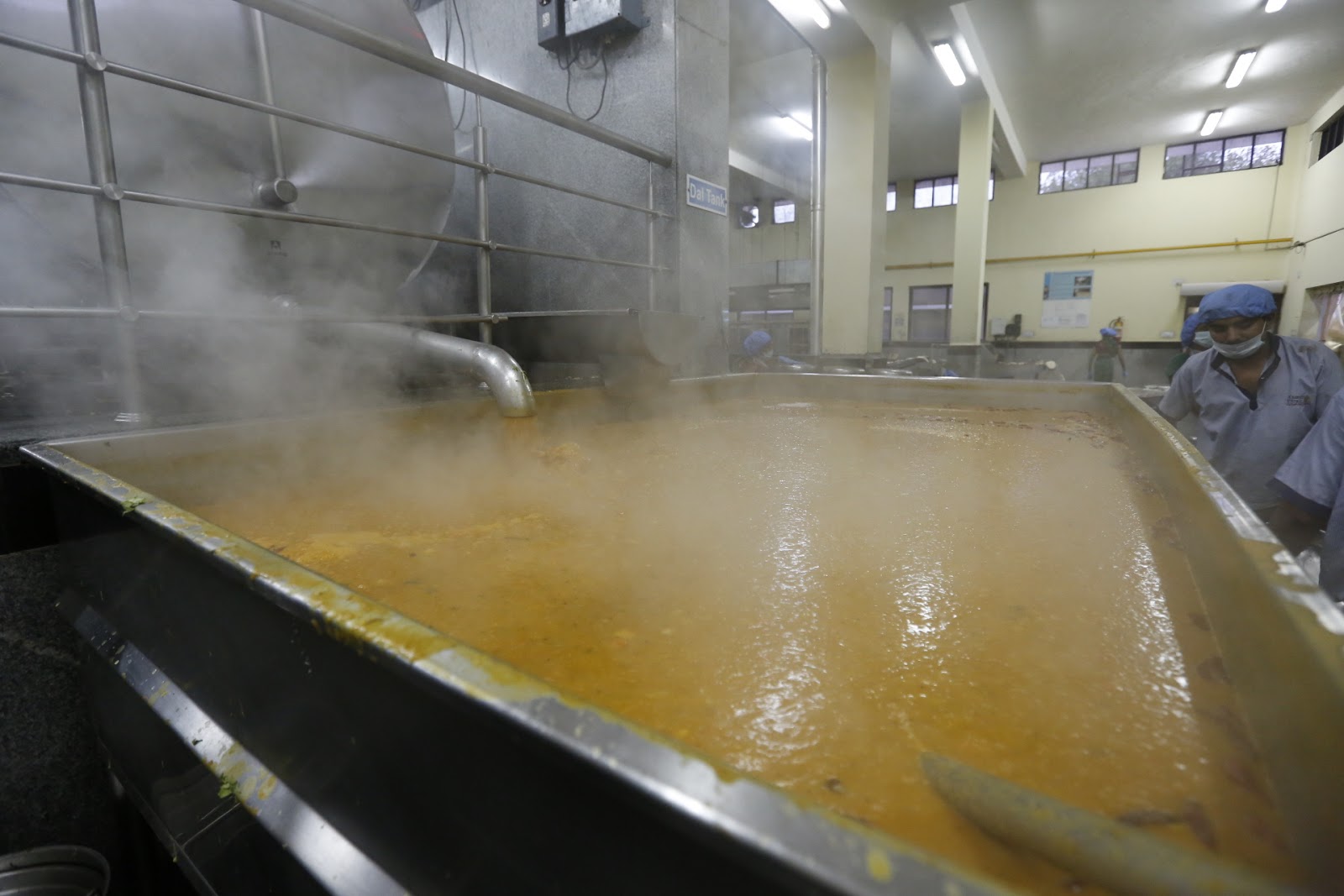
These kitchens are equipped with rice cauldrons, which can prepare 500 litres rice at a time, and sambhar cauldron, which can prepare 1,200 – 3,000 litres of dal at a time. Around 6,000 kg of rice, 4 – 5 tonnes of vegetables, and 6,000 litres of sambhar is prepared in just under four hours. Similarly, the roti-making machine used in kitchens in North India can dish out 40,000 rotis in an hour. The use of cauldrons with easy-tilt mechanism makes it easier to dispense food.

Roti Making Machine

Of the 24 locations across the country, Baran (Rajasthan) and Nayagarh (Orissa) employ the decentralised kitchen model, as the terrain of these places make transportation of food a tough task. So what Akshaya Patra has done, is employed local women’s self-help groups (SHGs) to cook the meals. The entire process is monitored by a team appointed by Akshaya Patra to ensure hygiene and efficiency. These two units help Akshaya Patra reach out to over 36,000 children every day.

Akshaya Patra uses custom-designed insulated vehicles to deliver food from kitchens to school. So firstly, there is no spillage during transportation, and secondly, children are served fresh, hot meal every day.

Successful Partnerships

Akshaya Patra is the largest NGO in India serving mid-day meals. It has got into a partnership with the Central Government as well as the State Governments of Karnataka, Uttar Pradesh, Rajasthan, Odisha, Andhra Pradesh, Telangana, Chhattisgarh, Gujarat, and Assam for the implementation of the Mid-day Meal Programme. The Government is the biggest donor for the organisation; may it be grants or grains.

Additionally, the Foundation works closely with various corporate houses and trusts and foundations to make the mammoth task possible. The Infosys Foundation and Jamsetji Tata Trust have helped Akshaya Patra to equip its kitchens with latest technology among other things. Similarly, Cisco has partnered with Akshaya Patra for its Global Hunger Relief campaign as a part of which the company raises funds for the Mid-day Meal Programme.

The list of partners is lengthy and includes names like the Caterpillar Foundation, The Hans Foundation, Kusuma Foundation, Give India, etc.

The Corporate Social Responsibility (CSR) provision in the Companies Act 2013, which makes it mandatory for corporates to spend at least 2% of average net profits for the last three years on CSR activities, has prompted many companies to come forward to help the society. Akshaya Patra is one of the several NGOs in India that have benefited from the same.

If feeding 1.5 million children is mammoth task, feeding 5 million children is an even bigger challenge, and that’s what The Akshaya Patra Foundation is aiming for. In doing so, we intend to reach out to new locations as well. In order to achieve this, we need your help. We accept tax deductible donations under Section 35 AC or Section 80 GGA, in which case the assesse is eligible for 100% deduction. Your contribution can help us reach out to more children … nourish more dreams and smiles.

Akshaya Patra Applies Technology to Run the Mid-day Meal Programme

There are several advancements in technology that has indeed made our lives easy but how much of these development can benefit society from a three sixty degree view. Technology has indeed made impact interventions but are we able to harness enough to benefit all? 

Talking about mid-day meal we can have a distinct view on its applications and benefits. The Mid-Day Meal Scheme is one of the largest free school lunch programme initiated by the Government of India. It is to ensure that children receive nutritious meals and can concentrate on studies rather than on earning a square meal. It is to tackle classroom hunger and promote education. In order to implement this, there are kitchens across the country to run the programme. As these kitchens have to cater to thousands and millions of children every day, they are categorised as centralised kitchens and decentralised kitchens. Centralised kitchens are mechanised kitchens equipped for mass production of mid-day meal and they also act as nodal kitchen for a set of schools in a particular region. This model of kitchens is viable and largely seen in urban areas.

Akshaya Patra Mega Kitchen

Signs of technological intervention are a sure sight in all the kitchens of The Akshaya Patra Foundation. A walk into any kitchen unit of the Foundation will give a well maintained factory-like feel. A closer look will reveal that it is a kitchen that bustles up every morning to prepare thousands and millions of meal. Right from huge rice cauldrons beginning with 500 litres cooking capacity and dal cauldrons with capacity of 1,200 litres to 3,000 litres of dal, there are mechanised roti making machines that can roll out 200,000 rotis from 6,000 kilograms of wheat flour. Not just for cooking, Akshaya Patra also utilises technology in storage and delivery process. There are cold storages in each kitchen to store ready-to-cook cut vegetables to retain freshness. For delivering the cooked food, the NGO makes use of custom-made insulated vehicles to control temperature loss so that freshness of the cooked meal remains intact till it is served to the children. In order to ensure safety and on-time delivery, methods like logistic charting for route optimization and GPRS are adopted and implemented in the kitchens.

Akshaya Patra Centralized Kitchen

There many more applications of technology that have helped in continuous increase of productivity, enhanced quality and improved service. These interventions have also potentially affected sustainability of each kitchen allowing the Foundation to increase its beneficiary base. Yet, Akshaya Patra continues to explore newer avenues to further advance its capacity of feeding millions of children and move forward in eradicating classroom hunger.


Follow us on:

 Akshaya Patra Pinterest

Knowing about Akshaya Patra Kitchens

Akshaya Patra Kitchen

The Akshaya Patra Foundation provides mid-day meal to millions of children through its kitchens in 24 locations and 10 states in India.  The cooking process is conducted in two kinds of kitchen unit: Centralised kitchen and decentralised kitchen. These Akshaya Patra Kitchens have adopted Six Sigma Methodologies.

The centralised kitchens of Akshaya Patra are large kitchen units that generally have the capacity to cook up to 100,000 meals. These kitchens serve a number of schools located around the unit. To ensure hygiene and safety these kitchen are automated. Akshaya Patra decentralised kitchens are the ideal solution to cook and serve children in locations with difficult geographical terrain and improper road connectivity. The Women Self-Help Groups (SHGs) under the regulation and supervision of The Akshaya Patra Foundation’s kitchen process and operations module run these decentralised kitchens.

All kitchens run by The Akshaya Patra Foundation follow a planned menu. The Akshaya Patra centralised kitchens are equipped with cauldrons, trolleys, rice chutes, dal/sambar tanks, cutting boards, knives and other similar equipment. The menu caters to the specific locale palates of the regions where food is served. The kitchens in North India are equipped with rice cauldrons and dal cauldrons. As roti is an integral part of the North Indian meal, the kitchens are equipped with roti making machines. The kitchens in South India are equipped with rice and sambar cauldrons.

Several measures, rules and regulations and standard procedures are meticulously observed continuously to ensure that children get the best food every day. There are quality assurance procedures during procurement of raw materials, standards in Storage, Handling, Preservation of raw materials, rules and regulations to ensure quality and safety during cooking, standards measures in food packing and transportation, steps in delivery and post-delivery and continual improvement methods.

The objective of The Akshaya Patra Foundation is to provide nutritious mid-day meal to all the beneficiary children every day on time without fail. That is the foremost priority as Akshaya Patra strives towards achieving its mission of feeding 5 million children by 2020.

Akshaya Patra Kitchen Begins Operation in Nepal

Akshaya Patra Kitchen
Food being cooked in cauldrons at the kitchen
The joint initiative of Jamsetji Tata Trust and Sipradian Sahayata Sanstha and The Akshaya Patra Foundation to set up a relief kitchen in Nepal began its operations on 19 June 2015. The first meal was served to 1,100 people of Bode location where people from worst affected areas have been provided makeshift accommodation. The kitchen provided fresh servings of rice, dal (lentils) and potato sabji(vegetable dish). Beginning with this Akshaya Patra will continue to provide freshly cooked food to the earthquake victims till stability is achieved in the Himalayan country.

The kitchen has been set up in a pre-engineered building with 2,500 square feet. 33 members of Akshaya Patra set up the entire facility in a record time of five days. This Akshaya Patra kitchen is equipped with four cauldrons- three with 600-litre capacity to cook rice and one with 1,200 litres capacity to cook dal. Other machines for the purpose of cutting vegetables and grinding are also a part of this Akshaya Patra relief kitchen. Strict adherence to hygiene and cleanliness has been employed in the kitchen. The kitchen is strategically located in Suryabinayak Chowk, Bhaktapur. Currently, this kitchen is serving food to 11 locations in and around Bhaktapur region namely Bhelukhel, Maheswari, Jella, Garun Kund, Kamal Binayak, Thulo Bayasee, Bayasee, Bode, Thali, Gokarneswar and Bhugmati.
Food For Nepal People
Food for Nepal People
Akshaya Patra Chairman, Madhu Pandit Dasa thanked the Government of Nepal, Jamsetji Tata Trust and Sipradian Sahayata Sanstha for their continued support in setting up the kitchen facility to provide relief aid in the form of clean and hygienic food  to the affected population of Nepal.

Know more about Akshaya Patra Kitchen Facility at Nepal at: http://www.akshayapatra.org/news


The Akshaya Patra Foundation, NGO in India has implemented the mid-day meal scheme to feed the future of India. The organization is feeding the government school children of 24 locations across 10 states in India.

Follow us: @AkshayaPatra on Twitter | TheAkshayapatraFoundation on Facebook |

Akshaya Patra Centralized Kitchen in Hubli for Mid Day Meal


A centralized model is one where all the cooking activities of a particular location are concentrated within one large kitchen.

Each centralized kitchen has the capacity to cook between 50 000 to 150 000 meals daily thus achieving economies of scale. Cooking takes place in mechanized, steam heated cauldrons custom built to reduce the cook to consume time.

Commissioner for Women and Child Welfare visits Akshaya Patra facility


Anita Rajendra, Commissioner for Women and child welfare department visited Akshaya Patra foundation recently to check the implementation of the program in Visakhapatanam.  
Anasuya, Regional Deputy Director, Kameshwaramma, Project Director and Y Sunanda,  Anganwadi Supervisor accompanied her during her visit.
The Women and Child Welfare Department has also shared the impact study report on Anganwadi centers after the introduction of Akshaya Patra.
The impact study shows that there is an improvement in the performance of students and there is an increase in the number of attendees for the spot feeding program for pregnant women and lactating mothers.
Akshaya Patra nutritional program was introduced on 03-01-2011 on experimental basis and was inaugurated by the Honorable Minister for Tribal welfare Sri.Pasupuleti Bala Raju. Currently Akshaya Patra caters 5 varieties of food from 10.30 am at Anganwadi centers. 


Back to School Campaign

Back to School Campaign
Donate for Children in Need

Akshaya Patra Annual Report 2015-16

I Share My Lunch

I'm Javeriya - An Aspiring footballer

Favourite Dishes of Beneficiaries

Follow Us

Facebook Twitter LinkedIn Pinterest Flicker Google plus

Popular Posts